The Presence of the Poor Clares in Polish Lands
The presence of the Sisters of Saint Clare in Poland is inseparably linked with the arrival of the Franciscan friars, today known as the Conventual Franciscans. The friars not only supervised and granted permission for the establishment of Poor Clare monasteries, but also provided them with spiritual and material support. As early as 1225, the Franciscans arrived in Prague, and by 1237 their presence in Kraków was confirmed. At that time, Polish lands belonged either to the Bohemian Province (covering Lesser Poland, Greater Poland, and the Duchy of Kalisz) or to the German Province (covering Silesia). The Bohemian Province played a particularly important role in the formation of Polish Poor Clare communities.
In Prague, the Poor Clares appeared thanks to Saint Agnes (1211–1282), who, through her correspondence with Saint Clare and Pope Gregory IX, developed a model of religious life adapted to the conditions of Central Europe. The Prague community gave rise to the first two Polish monasteries: in Zawichost (1245) and in Wrocław (1257).
Poor Clare Monasteries in the Middle Ages
Lesser Poland
The first Poor Clare community was established in Zawichost in 1245, when Blessed Salomea (1212–1268), a member of the Piast dynasty, took the Poor Clare habit and settled there with sisters from Prague. The monastery in Zawichost, known as the “monastery with twelve towers,” had a defensive character, which was necessary due to invasions by neighboring tribes and the Tatars. In 1257, following destruction caused by the Tatars and the relocation of the duchy’s capital to Kraków, preparations began to move the community. A new monastery was built in Skała near Kraków between 1259 and 1264. As the foundress, Salomea granted the settlement town rights in 1267. After her death, she was buried in Kraków, which contributed to the growth of her cult.
In 1316, the Poor Clares moved from Skała to Kraków, settling at the Church of St. Andrew the Apostle. Documents from 1318 confirm their presence on Wawel Hill, and papal approval for the new monastery was granted in 1325. For centuries, the sisters were involved in educational work—between 1802 and 1951, a school for girls operated there.
Stary Sącz
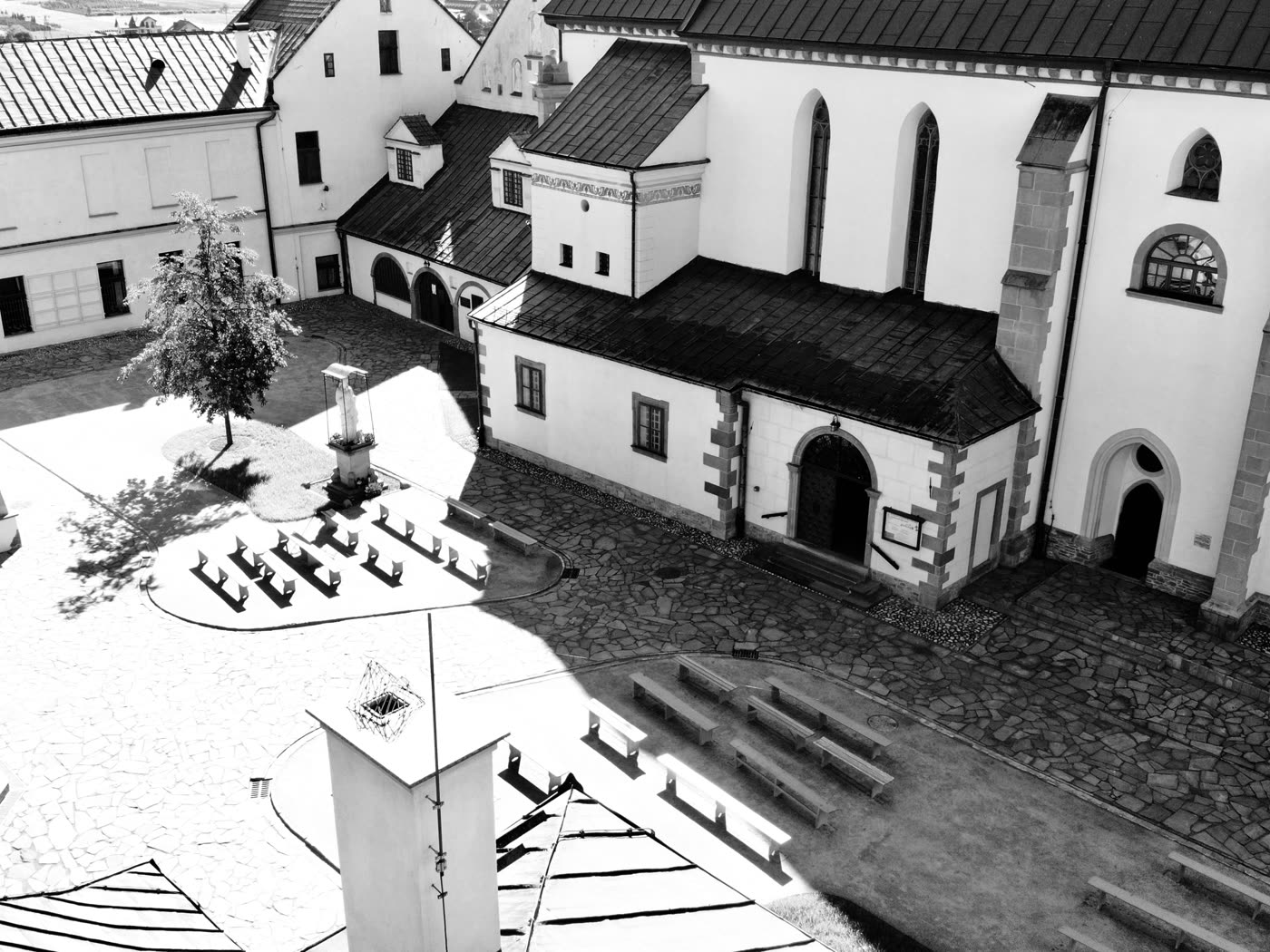
The monastery in Stary Sącz was founded by Saint Kinga (1234–1292), the wife of Bolesław the Chaste. After her husband’s death, Kinga dedicated her possessions to establishing a monastery, where sisters from Skała settled. The monastery could accommodate 70 sisters and 30 brothers. The community cultivated a high level of religious culture, reflected in literary and musical works. After Kinga’s death, the monastery became a place of pilgrimage. Closed by Austrian authorities in 1782, it survived by running a school for girls and was officially reestablished in 1811. Today, it functions as a contemplative monastery.
Greater Poland
A foundation of Poor Clares in Gniezno emerged from the monastery in Skała. Its initiator was Blessed Jolanta (1244–1298), the sister of Saint Kinga. In 1283, Jolanta established the monastery and entered it herself. A distinctive feature of the Gniezno monastery was the choir chapel, which formed part of the nave of the Franciscan church. Unfortunately, in 1865, the Prussian authorities dissolved the monastery and demolished its buildings.
Silesia
In Wrocław, the Poor Clare monastery was founded by Duchess Anna, sister of Saint Agnes of Bohemia. Despite opposition from Franciscan friars of the German Province, Anna—supported by the Pope—established the monastery in 1257. The Wrocław community became the mother house for further foundations in Strzelin (1260) and Głogów (1304).
The Significance of Poor Clare Monasteries
Poor Clare monasteries played a key role in the development of religious and intellectual culture in Poland. They were centers of prayer, education, and the veneration of their foundresses. Thanks to the support of rulers such as Bolesław the Chaste, Saint Kinga, and Blessed Jolanta, these monasteries survived difficult historical periods and remain, to this day, witnesses to Poland’s spiritual heritage.